Stress & everyday coping
Understand stress signals, build awareness of personal triggers and practise everyday strategies for responding to pressure.
Explore individual support → Make an enquiry
A useful workshop should leave people with something they can put into practice. AO Psychology can develop wellbeing sessions on stress, emotions, communication and coping for workplaces, community groups and other suitable audiences. We’ll discuss your group, the topic and the format before proposing a session.
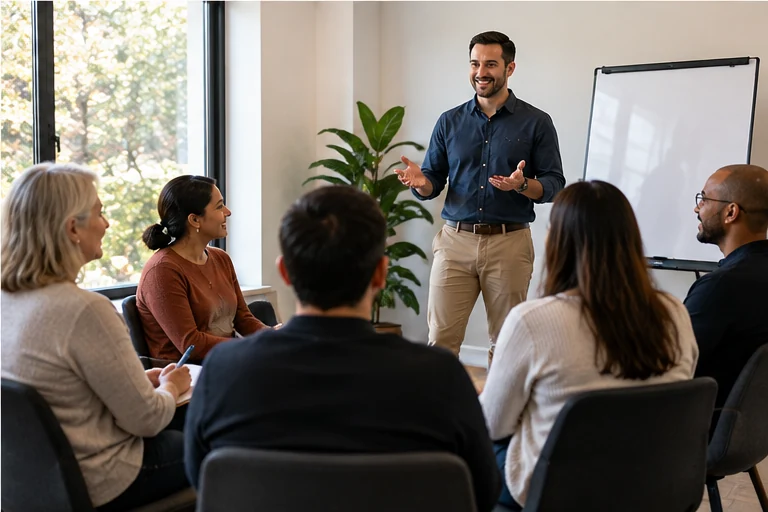
Explore possible formats, learning goals and how an educational session can be tailored to the people attending.
A wellbeing workshop is a guided group session focused on a practical topic. It might help people recognise stress, develop coping skills or communicate more clearly. Workshops use psychological education and activities; they do not replace individual counselling or clinical treatment.
Sessions can be shaped to the audience—for example, parents, community members, workplace teams or young people—and may combine a short explanation, guided discussion and useful exercises.
Thoughtful learning. Practical next steps.
Instead of relying on slides alone, a workshop might use an everyday scenario to explore how stress, emotions or communication affect a situation. Participants can reflect or practise a simple skill at a pace suited to the group.
For example, a communication session might compare ways of setting a respectful boundary, then explore a response participants could try in daily life. Sharing private health information is not required for these educational activities.
Enquire about a workshopWe start by understanding the group and what people hope to learn. The topics below are examples, not fixed packages. Any session depends on the agreed scope and availability.
Understand stress signals, build awareness of personal triggers and practise everyday strategies for responding to pressure.
Explore individual support →Recognise emotions, improve expression and introduce simple skills for pausing, regulating and seeking support.
Explore family support →Explore common communication patterns, respectful limits and ways to navigate challenging conversations.
Organisational support →Learn useful language for wellbeing, recognise when extra support may help and reduce confusion about available pathways.
Browse our services →A workshop is a guided learning experience, not simply a slideshow. It brings together accessible information, relevant examples and opportunities to reflect and apply ideas.
We start by understanding what your participants need and what you want them to leave knowing or being able to do.
Share the age group, number of participants, setting and the challenges or topics most relevant to them.
We discuss learning objectives, practical activities, accessibility, timing and whether online or in-person delivery fits.
We confirm the proposed format, content and arrangements, including any preparation or resources, before going ahead.
No. A wellbeing workshop is primarily educational and skills-focused. It is not a substitute for individual therapy or a comprehensive assessment. If a group needs therapeutic work, we would discuss the purpose and suitability separately.
We can discuss participants' ages, backgrounds, language needs and learning goals, then consider whether a suitable session can be designed. The final scope is agreed before delivery.
No. Group activities can focus on general scenarios and practical skills. Participants should not be required to share private health information to engage with an educational session.
Online or in-person delivery can be explored depending on the group, purpose and availability. The proposed format, accessibility needs and practical arrangements are confirmed in advance.
Workshop length, preparation and pricing depend on the audience, topic, delivery format and resources involved. We discuss those details and provide an agreed proposal before an engagement is confirmed.
We are currently considering workshop enquiries rather than advertising a fixed public timetable. Use the general enquiry form to describe your interests and preferred setting.
Workshops for organisations and self-guided digital programs serve different needs. Explore our developing program library for family-focused learning you can revisit at your own pace.
Understanding Your Child's Big Emotions — story-led education for parents of children aged 5–12.
See Programs & Resources →